AI Opportunity Assessment Report
- Executive summary
- Workflow maps
- Full list of AI opportunities
- ROI estimates
- 90-day plan
- 12-month roadmap
- Deployment guidelines
.svg)
AI Opportunity Assessment
A practical, faith-aligned approach to understanding how AI can strengthen your team, serve your customers, and honor what God has entrusted to you.
We begin by learning your goals, constraints, and the people God has placed under your leadership — so recommendations honor both your mission and your values.
During the pre-engagement Discovery call, we'll discuss:
Following our call, we'll distribute a survey to your employees to learn about:
We identify practical use cases rooted in service, integrity, and operational excellence — avoiding hype and focusing on what genuinely strengthens your work.
The first week of the engagement focuses on identifying potential AI opportunities for your business.
We'll interview 8-12 key players in your organization to understand:
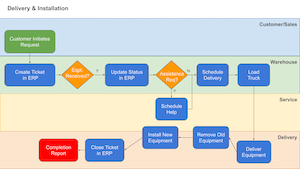
We'll then translate these insights into workflow maps and a list of AI opportunities tailored to your business.
Not every AI idea is wise or right. We help you evaluate impact, stewardship implications, human effects, and financial return so you can choose the best next step.
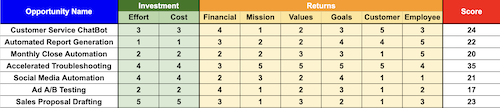
The second week focuses on evaluating and prioritizing the AI opportunities we've identified. We develop high-level ROI estimates for each opportunity, based on implementation costs and projected benefits.
More importantly, we create a prioritization framework that goes beyond financial metrics. This framework evaluates each opportunity based on its estimated ROI, alignment with your values, and contribution to your strategic goals—ensuring your AI initiatives serve both your bottom line and your mission.
A clear 90-day plan and 12-month roadmap that align business opportunity with faith-driven leadership principles.
At the end of the second week, we package our findings into a comprehensive written report and presentation deck.
We'll deliver these materials and schedule a dedicated walkthrough session with you and your team to discuss the findings, answer questions, and chart next steps.
Visual clarity on the processes where AI can reduce burdens and free your team to focus on higher-value, people-centered work.
Transparent scoring that weighs both business value and people impact — helping you invest where stewardship and strategy align.
A ready-to-share summary to guide prayerful, thoughtful decision-making with your leadership team.
Engagements start at $10,000.
AI can reduce repetitive burdens and create margin — giving your team more time for meaningful, relational, or creative work.
Other companies are moving fast. You can move wisely — using AI in ways that reflect your values and strengthen your witness.
Technology amplifies impact. Christian leaders have a unique calling to ensure it's used with discernment, care for people, and respect for truth.
This is a common concern for small business leaders (even myself for my own business), and it's completely understandable. AI implementation can feel like an expensive gamble, especially when margins are tight and resources are limited.
But here's the stewardship question we need to wrestle with: Can we afford not to explore AI?
Your competitors are likely already implementing AI solutions. More importantly, your customers are experiencing AI-enhanced service elsewhere—faster responses, more personalized interactions, fewer errors—and those experiences are shaping their expectations of every business they engage with.
The good news? Not all AI opportunities require significant investment.
As stewards of the resources God has entrusted to us, we shouldn't pursue AI for AI's sake. We should focus on opportunities that:
Many high-impact AI applications are surprisingly affordable: automated customer service responses, document processing, scheduling optimization, or content creation assistance. These tools often cost less than a part-time employee while delivering measurable time savings and error reduction.
The question isn't whether you can afford to implement AI. The question is: which AI opportunities can you not afford to miss?
Wise stewardship means evaluating each opportunity on its merits—its ROI, its alignment with your values, and its contribution to your mission. Some opportunities will be clear wins. Others won't make sense for your business. But making that determination requires looking, not assuming.
Many small business owners assume AI is only for large enterprises with dedicated IT departments and massive budgets. But that assumption is increasingly outdated—and it could put your business at a competitive disadvantage.
Here's the truth: AI tools are now more accessible to small businesses than ever before.
In fact, small businesses often see faster, more dramatic results from AI implementation than their larger counterparts. Why? Because you're more agile, you can move quickly, and you don't have layers of bureaucracy slowing down decision-making.
AI doesn't require an enterprise budget or IT team
Today's AI tools are designed for businesses of all sizes:
Consider these practical examples for small businesses: AI chatbots that handle common customer questions 24/7, email assistants that draft responses in your voice, scheduling tools that eliminate back-and-forth, inventory systems that predict demand, or bookkeeping software that categorizes expenses automatically.
Being small is actually an advantage. You can test AI tools quickly, pivot if something doesn't work, and implement changes without navigating corporate politics. Large companies envy that flexibility.
The question isn't whether you're big enough for AI. The question is: are you willing to explore how AI can multiply your small team's impact?
As faithful stewards, we're called to maximize what God has entrusted to us—whether that's two talents or ten. AI tools can help your small team serve more customers, reduce errors, save time, and focus on the work that truly requires a human touch.
Your size isn't a liability. It's an opportunity to be nimble, strategic, and faithful with the resources you have.
I used to think this too about contractors, retailers, professional services firms, manufacturers, and almost every other traditional industry. The reasoning goes: "AI is for tech companies. We're in a traditional business where relationships and craftsmanship are what matter."
But here's what that perspective misses: AI isn't about replacing what makes your industry unique. It's about eliminating the friction that keeps you from doing your best work.
Every business—regardless of industry—runs on workflows. You respond to inquiries. You schedule appointments. You create proposals. You manage invoices. You track inventory or project status. You communicate with customers and team members. These workflows exist whether you're building homes, providing legal services, running a restaurant, or managing a retail store.
AI works behind the scenes to support your expertise
Consider how AI might serve your business without changing what makes you special:
Your industry expertise, craftsmanship, and client relationships aren't threatened by AI—they're supported by it. AI handles repetitive tasks so you can focus on what requires judgment, creativity, and the human touch that defines your work.
Here's the real risk: While you're convinced AI doesn't apply to your industry, your competitors are quietly using it to respond faster, reduce errors, lower costs, and deliver better customer experiences. Your customers may not know they're experiencing AI—they just know they're getting faster, more accurate service.
The question isn't whether AI matters in your industry. The question is: which workflows are slowing you down, and could AI help you serve your customers more faithfully and effectively?
As stewards, we're called to work with excellence and wisdom. If tools exist that can help us reduce waste, serve customers better, and free our teams to focus on meaningful work, shouldn't we at least explore them?
AI doesn't redefine your industry. It helps you do what you already do—better, faster, and with fewer headaches.
Hi, I’m Russ McGuire. As a Christian and long-time business strategist, my work is shaped by a simple belief: leadership is stewardship. God entrusts business owners with people, resources, and opportunities — including new technologies like AI.
For more than 30 years, I’ve helped organizations navigate major technology shifts.
Today, I help Christian business owners use AI wisely, faithfully, and effectively — creating value while honoring the people and purposes God has placed in their care.
Short discovery call to confirm fit and scope.
Your information is confidential and used only for your assessment. We recommend AI practices that protect privacy, respect people, and uphold integrity at every step.